
December 3, 2021 marks 50 years since the beginning of the 1971 War which ended in a decisive military victory for India and the liberation of Bangladesh. Most analysts of the 1971 War agree that the IV Corps dash across the mighty Meghna river led by the brilliant General Sagat Singh was the turning point in the war, recalls military historian Colonel Anil A Athale (retd).
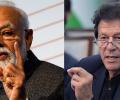
Modi's hardline policy towards Pakistan and J&K has created numerous leverages and bargaining positions that New Delhi can bring to the bargaining table and translate into concessions, argues Ajai Shukla.

'One lesson to emerge out of the Modi-Putin summit is that India can be more self-confident that it possesses inherent strengths to leverage its interlocutors to influence Pakistani policies,' says Ambassador M K Bhadrakumar.
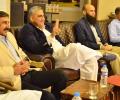
'Over the last year, Bajwa has created the environment to support bold moves on India. The ball is in India's court,' a senior Pakistan military officer tells Ajai Shukla.

Lieutenant General B S Raju, who will take over as the new DGMO, handed over the charge of the strategic XV Corps of the Army, which guards the Line of Control in Kashmir Valley, to Lt Gen D P Pandey.

It would be realistic to see India's position on the DGMOs joint statement more as 'engagement, different from dialogue', where our subsequent options could be decided depending on the realities of the situation on the ground, notes Rana Banerji, who headed the Pakistan desk at the Research and Analysis Wing, India's external intelligence agency.
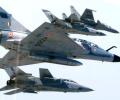
'For Pakistan, the comfortable old calculations and certainties are no longer valid.' 'Strikes on Indian targets now carry a high risk of retaliation and escalation,' notes Ajai Shukla.

However, there will be no bilateral meetings between Swaraj, Sitharaman with their Pakistani counterparts.
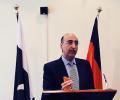
War is not a solution to problems between India and Pakistan and only "foolish" people would consider such an option, says Pakistan High Commissioner B S Basit.

'Increasing Indian influence meant "people here in Washington DC, in Brussels, in London or other world capitals don't talk about Kashmir".'

'The Indian version is that the two top diplomats merely exchanged pleasantries, while the Pakistani side characterised the encounter as an 'informal dialogue'.' 'The truth, as always in such piquant situations, is somewhere in between.' 'It stands to reason that ice has been broken,' says Ambassador M K Bhadrakumar.
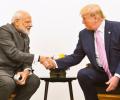
'From the Indian perspective, Trump's invitation to Imran Khan to visit the White House is a bitter pill to swallow,' points out Ambassador M K Bhadrakumar.

'Washington appears to be playing the long game, and making the argument to India that over the longer term, Russia -- sanctioned, cash-strapped, isolated by the West -- will no longer be a viable defence partner for India'

If the FATF lets Pakistan off the hook, which is to be expected, it would signify a big boost to Pakistan's standing in the fight against terrorism. Delhi, on the other hand, loses the propaganda advantage, states Ambassador M K Bhadrakumar.

Pakistan is once again becoming a frontline State in big-power rivalry. But this time around, Pakistan stands to gain out of its geography, observes Ambassador M K Bhadrakumar.
'Steve was the foremost strategic analyst on South Asia,' remembers Colonel Anil A Athale (retd).

'Ensuring through diplomatic means and in conjunction with strategic partners that India will not be required to fight a simultaneous two-front war with China and Pakistan.' Brigadier Gurmeet Kanwal (retd) lists what India must have in its national security strategy.

Leaders of the two countries, however, did discuss on Pakistan's nuclear safety and security which is an ongoing discussion.

Since the 1984 national elections, no party has won a clear majority in the lower house of Parliament, a US intelligence report has observed. Vicky Nanjappa reports.
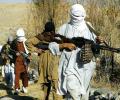
Pakistan National Security Advisor Sartaj Aziz brings to New Delhi a newfound Pakistani confidence, stemming from its leverage in Afghanistan, says Ajai Shukla

'They are aware that they have been unable to bring about any change in the security situation in Kashmir and have failed to internationalise the Kashmir issue.'
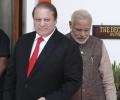
EAM Sushma Swaraj said that terror and talks cannot go together.
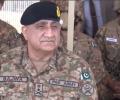
'The picture only looks worse from where Bajwa sits.' 'He sees a domineering India to the east, an unravelling Afghanistan and a complex Iran to the west, an overbearing China on the north and a US which is no longer an ally,' observes Shekhar Gupta.
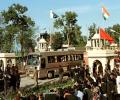
'Despite the subsequent events at Kargil and the October 12, 1999 military coup in Pakistan, the Lahore initiative firmly established Vajpayee's credentials as a crusader of peace,' says Colonel Anil A Athale (retd).
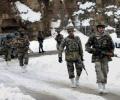
Within the army, there is growing concern that New Delhi will allow the Chinese to retain the territory they have occupied in the last month.
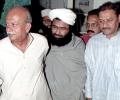
'Whichever way you look at it, it is a blow to the JeM and to the Pakistani army in general; the attack has taken place in mainland Pakistan and not in PoK.'
'The talks held in Bangkok, virtually on Indian terms, is an event where Pakistan seems to have blinked first.'

A group of former senior military and civil services officers has asked the government to cancel the proposed talks between the Prime Ministers of India and Pakistan in New York next month in view of unabated Pakistan-inspired terrorism against this country.
The United States on Wednesday warned that Pakistan faces a "serious" threat from the Taliban and offered its assistance to fight against terrorism after the recent attacks in Karachi.
Washington is signalling to Delhi that it can rely on American support in any great game vis-a-vis China. Delhi shouldn't fall into the trap, argues Ambassador M K Bhadrakumar.
Pakistan's holy trinity -- its government, military establishment and the ISI -- differ on Pakistan's domestic and foreign policy issues. So when India talks to Pakistan's political leadership it can't be sure that the promises can be delivered, says Brigadier S K Chatterji (retd).

India has conveyed its concerns to the top security and intelligence officials of the United States, the United Kingdom and Russia over the possible implications of Pakistan's links with the Taliban and various terrorist groups operating in Afghanistan for regional security and stability, people familiar with the development said.

'The Pakistani side was so cocksure of itself that it had come to the table with a pre-set agenda -- an agenda of unilateralism, knowing full well that nothing was going to come out of these talks,' says Rajeev Sharma.

Pakistan's ambassador to the United Nations Maleeha Lodhi launched a verbal dual against India.

Thimpu apparently didn't think it necessary to take Delhi into confidence. Bhutan is loathe to getting dragged into the geopolitical rivalry between India and China. And for Beijing, this was too good an opportunity to be missed to thumb its nose at the powers-that-be in Delhi, points out Ambassador M K Bhadrakumar.

'It is very significant that the president and the prime minister discussed Pakistan's efforts to take action against Lashkar-e-Tayiba and its affiliates.' 'This is something new and it demonstrates a recognition of Pakistan of the threats these terrorist groups pose to Pakistan and pose to other countries.'
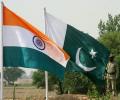
So far, almost every positive development in terms of the bilateral ties has been overtaken by innate hostility that is often driven by popular sentiments.
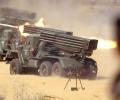
'Will it lead to a full-scale war? I doubt it.' 'But I do think there will be some kind of limited conflict.'

Moon Jae-in's visit will play a crucial role in exploring complementarities between India's Act East policy and South Korea's New Southern policy, says Dr Rahul Mishra.
'The Pakistani game plan in making its envoy in India to perform the last rites of a fledgling peace process is madness with a method.'
